Showing posts with label Hip Hop Mestizaje. Show all posts

Friday, February 4, 2011

Throwback Thursday: Celebrating Black History Month: Filipino American X blackness

Fictional depiction of Filipino "insurrectos" fighting U.S. colonizers. This screen shot is from found footage featured in the film Bontoc Eulogy. The Filipinos are played by African American actors.


In this edition of Throwback Thursday we celebrate Black History Month, which was founded by Carter G. Woodson whose connection to the Philippines as supervisor of schools during the early days of U.S. colonization makes the linkages of this blog to Black history so significant.

In my entry from April 2008, I discuss Filipino American participation in hip hop and the community's relationship to Black people and blackness. I've since refined my approach (for example, I've abandoned the term "mestizaje"), but my attempt to center Black history and positionality within a Filipino racial discourse is stronger than ever. Anyways, thanks for all the support and enjoy:

----

I just got done presenting a very short synopsis of some of my research questions at this year's Association of Asian American Studies Conference in Chicago.

I showed "Hip Hop Mestizaje" and did an 8 minute discussion on what the hell its supposed to be about. Thanks to everyone who liked the film and appreciated my research on the intersections of Filipinoness and Blackness. For those folks exploring similar topics, keep on keepin on, it's an emerging topic (I hope!). Can't wait for the Filipino Soul conference that is in discussion.

Here is the paper I shared at the conference:

"Right now I want to thank god for being me
My soul won't rest until the colony is free
1896 Revolution incomplete
Silence is defeat, my solution is to speak
Resurrect the legacy of martyrs I beseech
Time to choose a side: It's the mighty verse the meek
My big brother Free brought the word from the East
We're the bullet in the middle of the belly of the beast."

These are the lyrics of Geologic, the Pinoy emcee of the Seattle hip hop duo Blue Scholars. When decoding the meaning behind the lyrics, such as “I want to thank god for being me,” we can see that his references of Filipino nationalism are curiously reinforced by Five Percenter Nation of Islam rhetoric, which is a pedagogical and spiritual discipline rooted in sects of African American Muslim tradition. In this verse, “god” refers to Geologic himself. For those who are not familiar, in the Five Percenter tradition, “god” refers the original Black man, or the god on Earth. So the question we ask is, “why is a Filipino emcee uttering a clearly Afro-centric phrase?” In my thesis, I interrogate the uses of Blackness by Filipino American hip hop practitioners. I contend that for many Filipino Americans, Blackness is both a resource and referent in their process of racial identification, and complements an existing racialized and hybridized Filipino subjectivity. Hip hop serves as an appropriate case study to demonstrate the emergence of Blackness among Filipino Americans’ racialized expressions. The recent JabbaWockeez triumph are a prime example of Filipinos’ dedication and loyalty to hip hop cultural production.

By evoking the often-neglected role of the Afro-Americanization of Filipinos, it is my intention to bring into focus the formation of race-consciousness among young Pinoys and Pinays—an effort that is built from the interventions made by scholars who have documented the process of deracialization among Fil Ams involved in hip hop. While we may be well-aware of young Pinoy and Pinays’ efforts to deracialize themselves (i.e. becoming the real “invisible” in the Invisbl Skratch Piklz), what is happening when they attempt to bring race consciousness unabashed? What does a post-1980s, hip hop generation, race-conscious Filipino American identification look like?

As seen from the video, Filipino Americans have been immersed in certain realms of hip hop forms since the late 1970s, but their participation in the broader forms of Black performance traditions dates back to contact made by Black Buffalo Soldiers who arrived in the islands during the Philippine-American War. The Americanization of the islands through music, education, and culture certainly contributed to Filipino familiarity with their White colonizers, but with the Americanization of Filipinos was the simultaneous Afro-Americanization of Filipinos. Therefore, the identification with Blackness among Filipinos has precedence, a precedence that is essentially rooted in U.S. Empire and the concomitant resistance partnered by Black Buffalo Soldier and Filipino insurgents during the war. At the turn of the 20th century when the Jim Crow South was solidified and U.S. Empire reached the Philippines, Blacks and Filipinos were rapping to a different beat, one underpinned by colonial domination and racist ideology.

Filipino Americans’ hybridity (or the “mestizaje” that I use) mediates their identification with Blackness in both its aesthetics and cultural origins. Elizabeth Pisares writes of Filipino American artists’ “invisibility” and lack of racial discourse, which allows for a flexible identity formation, moving in-between Asian-ness, Latinidad, Whiteness and Blackness. Many young Pinoy/Pinay brothers and sisters have been making visible a constructed notion of their Filipinoness through hip hop. The Pilipino Culture Nights, whose organizers were once skeptical of the “modern” hip hop sections of the theatrical shows (as Filipino hip hoppers were accused of “acting Black”), are now almost incomplete without them; hip hop has become staple for many PCN troupes. In another example, at a recent “Filipino Hip Hop Renaissance” showcase organized by the Kababayan Pilipino and “The Dark Boys” Pinoy brotherhood at University of California, Irvine, a graffiti-style artwork displayed on one panel the Philippine star rising above the Manila skyline and the word “Lost,” and on the opposite panel were displayed blaring boombox speakers along with the word “Found” (artwork by Pia Banez and Rommel Dimacali). As if evoking the Five Percenter “Lost-Found” lesson, young Filipinos continue to process racial and ethnic identification in the context of Filipino cultural recuperation. Here, hip hop is the recuperator.

Hip hop’s rise in popularity in the 80s among a generation of youth of all colors gave its resonance mass appeal, and for young Pinoys and Pinays, this resonance interwove with their existing racialized story here in the States and a broader story informed by Spanish and U.S. Empire. Commenting on hip hop’s appearance in the lives of young Filipinos in the early 80s, Geologic said in an interview “we had to respond to [hip hop] in some way. We had to either be a part of it or resist it. And why would we resist it? It’s something that we can kind of relate to.”

Even though Latinidad and Asian-ness can be powerful sources of racial affiliation among Filipinos (with Whiteness as the neocolonial racial default), my interest is the Blackness that is left unregistered, unrecognized, and even denigrated. As Geologic puts it, “I think a lot of ways when people down talk hip hop in the Filipino community, I think they do it with a tinge of racism to it. Because like a Filipino hip hop artist isn’t as legitimate as Filipino musical playwright. You know. Or a Filipino novelist. When in fact those three—first of all if they are all writing in English, then they’re writing in a language that’s not theirs. You know, so then who’s to say what is Filipino and what’s not?”

Filipino hybridity not only provides rich analysis for comparative race studies, even more, it presents the intersectionality of racialized groups and deconstructs the built borders surrounding ethnic studies disciplines. While addressing the fictiveness of essentialized Filipino identity, investigations of Filipino American performance of Blackness demonstrates the possibilities and promises of unpacking interracial subjectivities—indeed putting Blackness at the center of analysis—while never abandoning the critique of Whiteness as forming the broader structure of power relationships.

So it is worth asking, “what does a post-1980s, hip hop generation, race-conscious Filipino American identification look like?” It can look like many things, and rocking the dance floor to funk breaks and dominating the DJ scene illustrates an un-ignorable cultural dimension, like a bright colored graff piece written on a painted and repainted road sign.

In closing, it is important to acknowledge that Filipino American performance of Blackness is not free of deserved criticism. As Joel Tan writes in “Homothugdragsterism,” “it didn’t bother me that Filipino Americans we re affecting and talking Black. What vexed me was the ways this adopted Blackness went unquestioned…” Uncritical Blackness as drag should be scrutinized, especially when affiliation with Blackness does not necessarily mean a respect for Black people. In addition, Blackness in its constructed hypermasculine dimensions and its gendered role imbedded in racial significance should be taken into consideration. So in an attempt to re-imagine greater dimensions of Filipino racial discourse, a gesture towards the Afro-Americanization of Filipinoness is worth generous attention, especially for a people whose prism of difference is molded from every direction. Geologic best summarizes this re-envisioning:

“Rewriting what it is to what it ought to be.
I be the emcee in the place not to be.
Under constant revision is the poem that I be.”


---

Tuesday, November 16, 2010

What makes a "People's Champion"?

Check out this great article by veteran hip hop authority Davey D, who is featured in the opening part of my 2007 documentary, Hip Hop Mestizaje (embedded in the right panel of this blog).

Manny Pacquiao the People’s Champ: Is that too Much for Floyd to Handle?

from Davey D's Hip Hop Corner
November 15, 2010

"...While the world watched and cheered, we’re sure a certain boxer with a big mouth and lots of money sat at home also watching. There is no doubt that Floyd ‘Money Making’ Mayweather has come to realize two unshakeable truths. First, he can’t beat Mr Pacquiao. Yeah, yeah, we heard all the talk about how he’s a skilled precision fighter, a true student of the game blah, blah, blah…Save it. He knows it, I know and you know it. Mayweather watched and realized this past Saturday night this is man he can’t beat.

The other thing he realized is that he’ll never be seen as one of the greatest, even with an undefeated record. As a world champ, he misread history and what it means when you hold such a title especially as a Black man. The ring was always symbolic of power we did not have.. Even with boxing legends like Sugar Ray Robinson, part of what made him great was his accomplishments in the midst of hard oppressions. the accomplishments of boxing greats like Joe Louis and Jack Johnson became a symbolic victories for all those who felt marginalized and oppressed. Their victory was our victory.

Manny Pacquiao has captured that spirit globally. Sadly Floyd Mayweather has misread the signs of today’s times and missed the opportunity to be ‘the people’s champ‘. If Mayweather and Pacman were to fight and he somehow won, Manny would still be seen as champ all over the world. A Mayweather victory would be a hollow victory. Mayweather does not have the admiration of the people especially globally, and no matter how much he brags or ‘adroitly ‘plays the role of villan’ aka the ‘man you love to hate’, he’ll never be seen as a man for the people. What a wasted opportunity...."
CONTINUE READING...

---

Friday, December 25, 2009

ARTIST SPOTLIGHT: Dillon serves Studies in Hunger


My brotha, my fam, my hip hop comrade Dillon (here for a more complete bio) dropped a new album Studies in Hunger. Representing Jacksonville, Florida and Atlanta, Georgia, Dillon will serve you like the glutton you are with the unique flavor of hip hop in the South. It's grimy, soulful, reverent to b-boy soundscapes, and well-studied in the execution of lyricism. And Dillon has been in the midst of this independent hip hop movement, and gathering from his latest album, he may be at the forefront.

I grew up with Dillon. In fact, he was my first friend (in fourth grade foo!) when I first moved to FL from CA. It was impressive to see the dude rock the show at TSI (see flyer above) to release his second album, which boasts a big name drop from Chuck D (who Dillon apparently cooked dinner for, but that's a different story) and rhymes from Akrobatic. Dillon has raised the bar, even when his first album (when he was known by the moniker MC Intellekt) was raw to the illest extent. His punchlines, cadence, and metaphors offer fun and smart wordplay.

Dillon defines himself on his own terms, moving away from Intellekt and becoming more confident in his own self, eccentricities and all. With knocks like "Stay Relative" paying homage to his family lineage, and as always, he includes drops from his mother and sister. "The greatest story you can tell is your own," he says.

And in Studies in Hunger you can tell Dillon and Paten Locke are having fun. Hip hop should be fun man!

And who is Paten Locke (and here)? Also known as Therapy, Paten Locke is one of Fil Am Funk's favorite producers. A member of the legendary J-Ville-grown Asamov crew (renamed the Alias Brothers), Locke knows the ear of the b-boy and lyricist enthusiast and he also holds down mic skills with authoritative command. Locke seems to capture a hip hop culture in Florida not known by many across the nation. Not the bouncy, T-Pain, Juvenile-type Southern hip hop, Locke captures the "4-elements" hip hop flavor that many folks in J-Ville and in the South (and yes, many Filipinos in the region) have been loyal to since the early 1980s. I documented a small bit of that scene in my short doc Hip Hop Mestizaje (see top right) in my interview with Alias Brothers Pinoy member DJ Basic. Studies in Hunger also continues an interesting candid, cartoony, pot-head-like stream-of-conscious skits utilized by the Asamov crew.

A mission of Fil Am Funk is to highlight hip hop culture from around the nation. The South has been slept on for a while. And just like Florida helped resuscitate the b-boy scene, if you're looking for quality hip hop music, Florida got what you need.

I found this 2006 article a while back, where Dillon aka Intellekt describes growing up with Pinoys and Pinays in J-Ville:

"'I learned from a young age how to stand out,' Intellekt said. He talks about his time growing up in Jacksonville, Florida, growing up as a white kid with a Filipino hip hop culture that 'totally determined where [he is] today,' cutting his teeth in talent shows to impress cute Filipino girls."

I'm glad these cute Filipino girls helped motivate a budding talent. Now, as a leading independent emcee, Dillon is creating music with a deeper hunger and ordering bigger plates. Get served.

----

Wednesday, November 18, 2009

Legend lives on (in San Francisco)!

Just informing yall that my short doc Legend will be screening at the 16th Annual Filipino American Cinefest in San Francisco this Friday. It will be showing alongside the films of fellow comrades Eric Tandoc and Florante Ibanez. If ya in the errrya, reprezentzzz.

FACINE16: The 16th Annual Filipino American Cinefest

The FACINE festival is the longest-running festival of its kind in North America that features films by and/or about Filipino/a and Filipino/a Americans. Now on its 16th year, the festival runs for two days, November 20-21, 2009 at the San Francisco Main Library.

PROGRAM 1
Friday, November 20, 2009
1-2pm

Our stories from the ‘hood

Legend (Mark Villegas, dir & prod; 5 min, 2009)- Legend highlights the DJ career of Isaiah Dacio (aka DJ Icy Ice). Navigating through cultural history of Filipino youth in Los Angeles during the 1980s and 90s, Ice narrates the vibrancy of Filipino talent in the mobile DJ scene. Starting as a young DJ in Carson, reaching fame as a member of the DJ crew the World Famous Beat Junkies, and succeeding as the owner of his DJ business Stacks Records, Ice tells the story of his immersion in a rich Filipino youth expression that continues its legacy.

Got Book? Auntie Helen’s Gift of Books (Florante Pete Ibanez, dir; UCLA Department of World Arts & Culture/Center for EthnoCommunications, prod; 8:45 min, 2005) - short documentary on Helen Brown, the founder of Pilipino American Reading Room & Library.

Sounds of a New Hope (Eric Tandoc, dir; Mass Movement & Sine Patriotiko, prods; 41 min, 2009) - Tandoc follows Filipino American rap artist, Kiwi, through his work with youth both in the US and the Philippines where he uses music to raise political consciousness.

--

Coincidentally, I'll be showing Legend in the Fil Am Experience class at UC Irvine on Thursday, November 19. Icy Ice will speak as an honored guest. He will talk about his experience as a Filipino in the hip hop industry. Thanks to him for blessing us.

Also, tonight I'll be screening my earlier doc Hip Hop Mestizaje in Florante Ibanez's Fil Am Experience class at Loyola Marymount University, near LAX.

This condensed Fil Am hip hop-edness week is purely coincidental. But glad its happening. Bring it.

----

Thursday, September 24, 2009

Hip Hop Mestizaje in San Francisco! Yee!

Hip Hop Mestizaje will be showing in San Francisco on Sunday, October 4th, along with other great films. Thanks Kularts!! I'll try to make it to the Q&A, but no promises...


PeliKULa! Pin@y Film Series
First Sundays of the Month

Dim the lights, silence your cell phones, butter your popcorn, sit back and relax as Kularts presents its first Pin@y Film series featuring works by today's leaders in cutting-edge Pin@y cinema.

5pm, Sun OCT 4

Art for Social Change (Documentaries) Admission: $7
Tickets: www.brownpapertickets.com/event/79743

Featuring:

Hip Hip Mestizaje: Racialization,
Resonance, and Filipino American
Knowledge of Self

Director: Mark Villegas
Why Filipinos, why hip hop? A coast-to-coast exploration of Filipinos immersion into the hip hop movement, highlighting the cultural and racial impact of colonization on Filipino artists.

Sounds of a New Hope
Director: Eric Tandoc
Co-presented by ALAY
Growing up around LAs neighborhood gangs in the 90s, a young Filipino-American named Kiwi (Jack DeJesus) became an MC and community organizer, using hip-hop to raise consciousness
for genuine democracy. Through sharing life experiences, beats, and rhymes, youth from San Mateo to Metro Manila make connections across oceans that inspire the next generation to continue the ongoing struggle for freedom.

Showman Shaman
Director: Egay Navarro
Free-thinking independent artists catapulted Baguio into a vital art center of the Philippines in the late 80s such as Roberto Villanueva's art installation of his own cremation - outdoors, in the middle of Baguio City, mourners circled his funeral pyre, chanting and dancing to the beat of gangsa gongs.

Huna Huna
Director: Wilfred Galila
A haunting art film calling for environmental awareness and action in response to the largest oil spill in Philippine history.


Q&A Panel: Eric Tandoc, Suzanne Llamado (Baguio Arts Guild), and Wilfred Galila

...Stay Tuned for The Dark Side: Pin@y Horror and More! (NOV 1)

---

Monday, August 17, 2009

Watch Hip Hop Mestizaje now!


I posted up my short documentary "Hip Hop Mestizaje: Racialization, Resonance, and Filipino American Knowledge of Self." I started shooting this film back in 2006, so it may be a bit dated cuz so many things happened since then, such as the rise of new Pinoy/ay artists, new albums dropped, and this whole ABDC phenomenon. The experience of making this film was transformational for me since I got to sit down with talented bruthas and sistas who represent a whole generation of Fil Ams creating and defining the meanings of our diasporic experiences. Plus, really, I'm always a fan first (you betcha I was mad geeked the whole time).

"Hip Hop Mestizaje" congeals Fil Artists from coast-to-coast--from the South, Northeast, West, and Pacific Northwest--and forms a narrative that partially explains why Filipino Americans are so loyal to hip hop: that being our racialized colonial history (and all its funkiness!). Thus, many of us seek to find "knowledge of self" via hip hop, poetry, Barrio Fiestas, or Pilipino Culture Nights. Right? Anyways, "Hip Hop Mestizaje" is a very small part of hopefully bigger projects to come. You can read more about this topic of colonization and racialization in an earlier post from 2008.

Props to all the artists and performers who took the time to talk to me: Kuttin Kandi, Alfie Numeric, Paulskee, Basic, Geologic, and David Araquel. Props to the homey Lakan de Leon for giving some kinds words below. His pioneering film, Beats, Rhymes, and Resistance: Pilipinos and Hip Hop in Los Angeles set it off for many Fil Ams to really take this "Fil Ams in hip hop" thing seriously.

Peep the reviews from close friends and colleagues! Thanks yall!


"Mark Villegas' Hip Hop Mestizaje continues what we tried to do back in the day--document the dynamic contributions of Pilipino Americans to Hip Hop, as well as understand why the artforms within it speak to us so personally and profoundly. While it has been over a decade since our film came out, I am excited to know that Pinoys and Pinays continue to shape and innovate this rich culture, and in turn connect their stories to the larger struggles of all people of color seeking freedom and justice through expression."

- Lakan de Leon, co-creator of Beats, Rhymes, and Resistance: Pilipinos and Hip Hop in Los Angeles

"Mark's short film 'Hip Hop Mestizaje' provides an already hip hop-knowledgable or hip hop head audience with an introductory look at the presence of Filipino-Americans in contemporary hip hop life. It opens the book for folks interested in learning more about their Brown-yet-Asian family who they undoubtedly meet at shows, community events, and on the block...So they may understand just why it is that we're in hip hop in such large numbers, not metal or punk (though we rep rather well in those arenas too)."

-Kristia, type-scholar/writer (featured in my spotlight), Doorknockers

"With a diversity of insightful and prominent voices from across the Filipino hip-hop spectrum, Hip Hop Mestizaje delves into the shared history of struggle that prompted Filipinos in America to embrace hip-hop culture."

-Eric Tandoc, DJ, filmmaker of Sounds of a New Hope, Massive Movement
TV

"Hip Hop Mestizaje is a necessary exploration of U.S. Pin@y critique and contributions to popular culture, namely hip hop. Villegas highlights the ways in which U.S. Pin@y experiences align with other communities of color, but more importantly signals the tensions that push the building of Pin@y identity, art, and culture."

-Tracy La Chica Buenavista, Professor of Asian American Studies, California State University at Northridge

"I feel that this is a great documentary piece by my man Mark Villegas that gives you a glimpse into the world of Filipinos in Hip Hop. It shows how Hip Hop has helped them find themselves, and how it became thee medium of expression. This is a must watch for all Filipinos that want to gain a better understanding of why our community is so ingrained in Hip Hop Culture."

-DJ Icy Ice, World Famous Beat Junkies, Power 106

"...Mark highlights...a non-West Coast-centric viewpoint that showcases a varied yet collective experience." CONTINUE READING...

-Ninoy Brown, FOBBDeep
---

Monday, July 6, 2009

Live and Direct from Manila: Part IV: Mestizaje Talaga!

"Fusion" banner for the "Looking for Juan Outdoor Banner Project" that addresses the complexity of Filipino identity displayed across the University of the Philippines, Diliman.

"Shoes ko po!" a playful corruption of "Dyos ko po," or "my God!" This sign succinctly illustrates the English, Spanish, and Filipino remixing in everyday Philippine language. (Dr. Seuss Maryosep!)

Throughout the Philippines
, it is not hard to see the mixture of various languages ranging from Philippine varieties, American English, Spanish, Chinese, and Arabic. From the store names at the extravagant SM Malls, to the ever-popular spoof t-shirts, to the fuming jeepneys, language play and remixing is integral to everyday life in the Philippines. Simply talking to Filipinos, they like to invert and restyle not only Spanish/English words, but also Filipino words (like "astig" for "tigas" and "yosi" for "cigarillo"...there's much more, maybe you can think of some).

With language play such a central part of Philippine society, why is hip hop continually relegated to the margins? Language creativity in hip hop seems like a complimentary fit in this society. Why is it "jologs"-- I guess a rough translation would be "ghetto"?

So, maraming props para sa mga Filipino hip hop artists doin tha damn thang. Keep up the noble struggle!

Yo, global Filipino society is such a turntablists' psychodelic dream...diba?

Friday, January 9, 2009

Beats, Rhymes, and Resistance: A decade later


Before I get to "Beats, Rhymes, and Resistance," I'd first like to address the relationships between culture and politics. In the shadow of a historical transition to power with Barack Obama's presidency (what could be going through Jesse Jackson's mind right now?), there lingers many violent and disturbing acts of injustices. From the killing of Oscar Grant and shooting of Robert Tolan to Israel's grossly disproportionate military aggresion toward Palestinian people (and here), these examples are just a few of the innumerable power struggles that poor, disenfranchised, hungry, and marginalized women, men, and children live through everyday.

Obama, Grant, and Tolan

We will not go through a laundry list of oppression here. But as hip hop "heads" we know well the role culture plays in spaces of oppression and inequality. Where there is injustice there seems to always be a cultural response/expression that challenges injustice: music, dance, storytelling, language, paintings, etc. Hip hop is one mode of expression here in the States and is arguably employed with more political intensity among heads in Cuba, Germany, the Philippines, Kenya, etc.

However, the homey M.dot argues in the "Model Minority" blog: "Hip Hop isn't political. A Hip Hop show isn't political. An album isn't political." Please read her entry.

How important does cultural production (art, language, music, poetry, theater, etc.) play in radical/progressive political mobilization?


It's been more than a decade since the making of the documentary film "Beats, Rhymes, and Resistance: Pilipinos and Hip Hop in Los Angeles," which features some influential Fil Am hip hop artists (in their "younger" years!) such as Kiwi, Babu, Faith Santilla, DJ Symphany, and Icy Ice, and many others. It highlights the "cultural liberation" (as Faith Santilla says in the film) that hip hop brings to Fil Ams...the radical expressions that hip hop cultivates. "Hip hop," as DJ Dwenz says in the film, "is the voice of inner city youth." In this sense, hip hop is seen as a motivating "force" in political struggle...hip hop is political.

"Beats, Rhymes, and Resistance" is probably the first work that seriously tackles the topic of Filipinos in hip hop.
Lakandiwa de Leon's "Filipinotown and the DJ Scene" (here) resonates with the film (as Lakan is a co-director) and goes into more depth with gang culture and colonization. For those who have watched "Hip Hop Mestizaje," you can see how much the film influences my own work. It has paved the way for many young folks who are seriously interrogating this subject.

But, how relevant is this film today?
Given the state of hip hop in 2009, is the film's focus on hip hop's political role still applicable?

Or is M.dot right, hip hop is really less political than people may think?

Peep the film here (thanks to Lakandiwa de Leon):


For Palestine, for the family of Oscar Grant, for all people looking for justice, in whatever mode we strive for a better society (whether it be hip hop culture or not), may we always move forward to love and justice.

Saturday, April 19, 2008

Schola Ballin in the Go

So I just got done presenting a very short synopsis of some of my research questions at this year's Association of Asian American Studies Conference in Chicago.

I showed "Hip Hop Mestizaje" and did an 8 minute discussion on what the hell its supposed to be about. Thanks to everyone who liked the film and appreciated my research on the intersections of Filipinoness and Blackness. For those folks exploring similar topics, keep on keepin on, it's an emerging topic (I hope!). Can't wait for the Filipino Soul conference that is in discussion.

Here is the paper I shared at the conference:

"Right now I want to thank god for being me
My soul won't rest until the colony is free
1896 Revolution incomplete
Silence is defeat, my solution is to speak
Resurrect the legacy of martyrs I beseech
Time to choose a side: It's the mighty verse the meek
My big brother Free brought the word from the East
We're the bullet in the middle of the belly of the beast."

These are the lyrics of Geologic, the Pinoy emcee of the Seattle hip hop duo Blue Scholars. When decoding the meaning behind the lyrics, such as “I want to thank god for being me,” we can see that his references of Filipino nationalism are curiously reinforced by Five Percenter Nation of Islam rhetoric, which is a pedagogical and spiritual discipline rooted in sects of African American Muslim tradition. In this verse, “god” refers to Geologic himself. For those who are not familiar, in the Five Percenter tradition, “god” refers the original Black man, or the god on Earth. So the question we ask is, “why is a Filipino emcee uttering a clearly Afro-centric phrase?” In my thesis, I interrogate the uses of Blackness by Filipino American hip hop practitioners. I contend that for many Filipino Americans, Blackness is both a resource and referent in their process of racial identification, and complements an existing racialized and hybridized Filipino subjectivity. Hip hop serves as an appropriate case study to demonstrate the emergence of Blackness among Filipino Americans’ racialized expressions. The recent JabbaWockeez triumph are a prime example of Filipinos’ dedication and loyalty to hip hop cultural production.

By evoking the often-neglected role of the Afro-Americanization of Filipinos, it is my intention to bring into focus the formation of race-consciousness among young Pinoys and Pinays—an effort that is built from the interventions made by scholars who have documented the process of deracialization among Fil Ams involved in hip hop. While we may be well-aware of young Pinoy and Pinays’ efforts to deracialize themselves (i.e. becoming the real “invisible” in the Invisbl Skratch Piklz), what is happening when they attempt to bring race consciousness unabashed? What does a post-1980s, hip hop generation, race-conscious Filipino American identification look like?

As seen from the video, Filipino Americans have been immersed in certain realms of hip hop forms since the late 1970s, but their participation in the broader forms of Black performance traditions dates back to contact made by Black Buffalo Soldiers who arrived in the islands during the Philippine-American War. The Americanization of the islands through music, education, and culture certainly contributed to Filipino familiarity with their White colonizers, but with the Americanization of Filipinos was the simultaneous Afro-Americanization of Filipinos. Therefore, the identification with Blackness among Filipinos has precedence, a precedence that is essentially rooted in U.S. Empire and the concomitant resistance partnered by Black Buffalo Soldier and Filipino insurgents during the war. At the turn of the 20th century when the Jim Crow South was solidified and U.S. Empire reached the Philippines, Blacks and Filipinos were rapping to a different beat, one underpinned by colonial domination and racist ideology.

Filipino Americans’ hybridity (or the “mestizaje” that I use) mediates their identification with Blackness in both its aesthetics and cultural origins. Elizabeth Pisares writes of Filipino American artists’ “invisibility” and lack of racial discourse, which allows for a flexible identity formation, moving in-between Asian-ness, Latinidad, Whiteness and Blackness. Many young Pinoy/Pinay brothers and sisters have been making visible a constructed notion of their Filipinoness through hip hop. The Pilipino Culture Nights, whose organizers were once skeptical of the “modern” hip hop sections of the theatrical shows (as Filipino hip hoppers were accused of “acting Black”), are now almost incomplete without them; hip hop has become staple for many PCN troupes. In another example, at a recent “Filipino Hip Hop Renaissance” showcase organized by the Kababayan Pilipino and “The Dark Boys” Pinoy brotherhood at University of California, Irvine, a graffiti-style artwork displayed on one panel the Philippine star rising above the Manila skyline and the word “Lost,” and on the opposite panel were displayed blaring boombox speakers along with the word “Found” (artwork by Pia Banez and Rommel Dimacali). As if evoking the Five Percenter “Lost-Found” lesson, young Filipinos continue to process racial and ethnic identification in the context of Filipino cultural recuperation. Here, hip hop is the recuperator.

Hip hop’s rise in popularity in the 80s among a generation of youth of all colors gave its resonance mass appeal, and for young Pinoys and Pinays, this resonance interwove with their existing racialized story here in the States and a broader story informed by Spanish and U.S. Empire. Commenting on hip hop’s appearance in the lives of young Filipinos in the early 80s, Geologic said in an interview “we had to respond to [hip hop] in some way. We had to either be a part of it or resist it. And why would we resist it? It’s something that we can kind of relate to.”

Even though Latinidad and Asian-ness can be powerful sources of racial affiliation among Filipinos (with Whiteness as the neocolonial racial default), my interest is the Blackness that is left unregistered, unrecognized, and even denigrated. As Geologic puts it, “I think a lot of ways when people down talk hip hop in the Filipino community, I think they do it with a tinge of racism to it. Because like a Filipino hip hop artist isn’t as legitimate as Filipino musical playwright. You know. Or a Filipino novelist. When in fact those three—first of all if they are all writing in English, then they’re writing in a language that’s not theirs. You know, so then who’s to say what is Filipino and what’s not?”

Filipino hybridity not only provides rich analysis for comparative race studies, even more, it presents the intersectionality of racialized groups and deconstructs the built borders surrounding ethnic studies disciplines. While addressing the fictiveness of essentialized Filipino identity, investigations of Filipino American performance of Blackness demonstrates the possibilities and promises of unpacking interracial subjectivities—indeed putting Blackness at the center of analysis—while never abandoning the critique of Whiteness as forming the broader structure of power relationships.

So it is worth asking, “what does a post-1980s, hip hop generation, race-conscious Filipino American identification look like?” It can look like many things, and rocking the dance floor to funk breaks and dominating the DJ scene illustrates an un-ignorable cultural dimension, like a bright colored graff piece written on a painted and repainted road sign.

In closing, it is important to acknowledge that Filipino American performance of Blackness is not free of deserved criticism. As Joel Tan writes in “Homothugdragsterism,” “it didn’t bother me that Filipino Americans we re affecting and talking Black. What vexed me was the ways this adopted Blackness went unquestioned…” Uncritical Blackness as drag should be scrutinized, especially when affiliation with Blackness does not necessarily mean a respect for Black people. In addition, Blackness in its constructed hypermasculine dimensions and its gendered role imbedded in racial significance should be taken into consideration. So in an attempt to re-imagine greater dimensions of Filipino racial discourse, a gesture towards the Afro-Americanization of Filipinoness is worth generous attention, especially for a people whose prism of difference is molded from every direction. Geologic best summarizes this re-envisioning:

“Rewriting what it is to what it ought to be.
I be the emcee in the place not to be.
Under constant revision is the poem that I be.”

-------------------------------------

On another relevant note, big ups to Dean Saranillo for presenting on the representation of Hawai'i in the 1893 Chicago World's Columbian Exposition, and organizing the panel on Asian Americans, Indigenous sovereignty, and U.S. Empire. Andrea Smith, a professor at the University of Michigan, who made closing remarks for the panel, opened up my world with her analysis of white supremacy. Here are her three pillars of white supremacy (which is applied to people of color according to the logic of the U.S. nation-state): 1. People as property (Slavery), 2. People destined for genocide (Native indigenous people in the U.S.), 3. Orientalism (the foreign, threatening Asia in perpetual war with the West, i.e. War on Terrorism). WOW.

----------------------------

In retrospect, here are some of the questions asked by the audience for my panel:

1. "If Blackness is a replacement for a default Whiteness, what justice does that do to being Filipino (i.e. where is the Filipino part in Filipinoness)?" (roughly)

2. "What is the difference when Filipinos participate in hip hop, and when South Asians or East Asians participate?"

3. "How do these Fil Am artists reconcile the fact that hip hop is very commercial?"

4. "Yo, what's that thing on your eye?"

Here is a question I just ask myself, aside from this panel: "How do Filipinos' resonance with Islam (being that large parts of the Philippines is heavily Muslim, and many of our ancestors have Muslim traditions) shape the fact that these hip hop participants identify with Five Percenter ideology and North American Black Islam in general? How much does Islam travel alongside Blackness in threading the complex fabric of a hip hop generation Filipinoness?"


Saturday, March 1, 2008

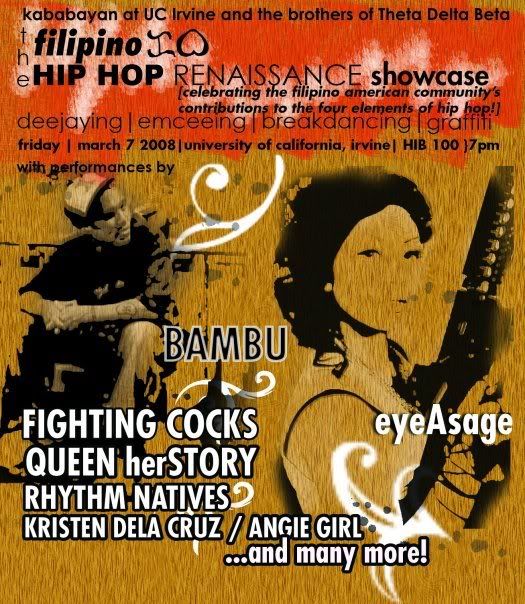
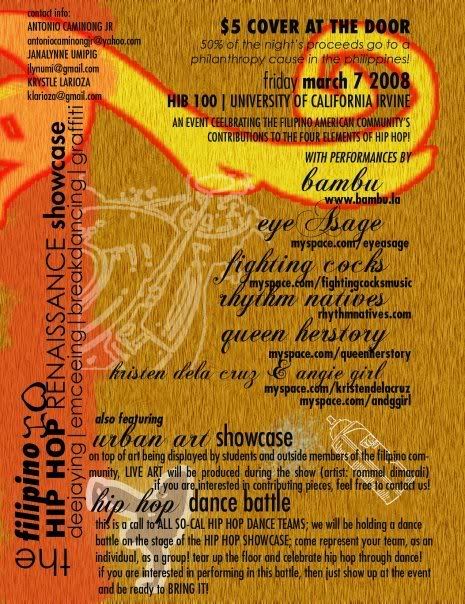
Filipino Hip Hop Renaissance Showcase: See you there!

I'mma be reppin' "Hip Hop Mestizaje" at this event at University of California, Irvine on Friday, March 7. See you there Kaba! (Peace Antonio)


UDPATE (3-8-08):
Thanks for an incredible night Antonio, Jana, Doris, and everyone! It was a huge success, thanks for letting me a small part of it. TDB and Kaba fo lyfe. Ya'll are inspiring and give life to consciousness, art, and community. Keep on doin what you do. Anyone got pictures to share?

Saturday, August 18, 2007

Hip Hop Mestizaje Showing at Festival of Philippine Arts and Culture


To all of my adoring fans, I am pleased to announce that my short documentary/multimedia project "Hip Hop Mestizaje: Racialization, Resonance, and Filipino American Knowledge of Self" will be featured at the 16th annual Festival of Philippine Arts and Culture (FPAC) in the Pinoy Visions tent.

FPAC is happening at Point Fermin Park in San Pedro on Sep. 8-9. Peep the website for more info: Fil Am Arts

Support community arts! Represent at FPAC this year (if you're on the West Coast)!

Also, don't forget about the famed FPAC Amateur DJ Battle, happening the Sunday of FPAC. The battle is brought to you by Stacks Records.